His desire for converting the Irish did not find favor with his superiors, mainly because of his defective education, for which he had never been able to compensate properly. Upon the death of Palladius, whom Pope *Celestine I had sent to the Irish as their first bishop in 431, Patrick was appointed his successor. His mission concentrated on the west and north of Ireland, where nobody had preached the gospel before. Having secured the protection of the local kings, he toured the country extensively and made numerous converts. Church organization had to be adapted to the political and social conditions of Ireland. Since there were no towns on the Roman pattern, Patrick established episcopal churches with quasi-monastic chapters as were found not infrequently on the Continent, especially in Gaul. Although he never mentions his own see, the claim of Armagh to be Patrick's church, though not recorded before the 7th century, seems to represent a genuine tradition. The clergy was originally recruited on the Continent (Gaul) and in Britain, but later increasingly from among the native converts. Patrick also propagated monasticism in the primitive form as practiced in the islands off the Mediterranean coast of Gaul.
In his missionary work he had to face frequent dangers to his freedom and even to his life. The Druids were probably his chief opponents. Patrick's conduct of the mission was severely criticized by the British clergy and also, it seems, by some persons in Ireland. Things would appear to have come to an issue when Patrick demanded the excommunication of the British Prince Coroticus, who during a retaliatory raid on Ireland had killed some of Patrick's converts and sold others into slavery. To his critics Patrick replied with his Confessio, written in his old age.
Writings. Of the writings that go under Patrick's name, his Confessio and the letter (Epistola) concerning the raid of Coroticus are commonly accepted as genuine. The Confessio is an account of Patrick's spiritual development and a justification of his mission, but above all it is a homage to God and thanksgiving for His grace, for having called Patrick, an unworthy sinner, to the apostolate. Autobiographical and historical detail are merely incidental and often difficult to interpret.
The letter is directed partly against the raiders and Coroticus, their leader, partly against the higher clergy of Britain and their scornful attitude toward the Irish bishop. Both works are written in an unusual mixture of Biblical and Vulgar Latin, which often results in strained and obscure language.
Opinion is divided about the authenticity of the Dicta (Sayings) of Patrick in the Book of Armagh, especially the first one, which refers to a sojourn on the Tyrrhene Islands, and the last one, which urges the chanting of Kyrie eleison, Christe eleison at all canonical hours. The canons of a circular letter issued by Bishops Patricius, Auxilius, and Iserninus after the socalled synod of St. Patrick, are probably substantially genuine. Ecclesiastical life as implied in this document, and in particular the frequent references to diocesan jurisdiction of bishops and to canonical discipline, are consistent with a 5th-century date and would not fit into the pattern of the Irish monastic Church of later times. A number of these canons are quoted under Patrick's name in the Collectio Hibernensis alongside others that are spurious. The beautiful Old Irish morning prayer known as "The Breastplate of St. Patrick" is of later date than the saint's lifetime.
Doetrine. Patrick was a man of action, with little inclination for learning. His writings are proof of his firm belief in his vocation, of his devotion to his cause, and of his courage and humility. His "voices"-foretelling his escape from captivity, calling him to the Irish apostolate, comforting him when in disgrace-are for the most part capable of a perfectly natural explanation; only the experiences related in the Confessio (ch. 24, 25) have the characteristics of mystical prayer.
Of his doctrine, little can be stated beyond its orthodoxy. A certain emphasis in his teaching regarding grace might possibly be interpreted as anti-Pelagian. The credal statements in his Confessio (ch. 4) echo a formal creed of Gallican type. Patrick's Biblical text, as far as can be judged, is also Gallican. Chronology. The only contemporary sources fFr Patrick's life are his genuine writings and the entries concerning St. Germain and Palladius in the Chronicle of *Prosper of Aquitaine. The former are, unfortunately, not precise enough for even approximation of an absolute chronology of the events referred to; they merely place Patrick within the 5th century. The Confessio does contain elements of a relative chronology: capture at the age of 16; escape from slavery at 22; some form of ecclesiastical censure because of a sin he had committed when barely 15 years old, disclosed "after 30 years"-but the date upon which they are reckoned is not clear. On the other hand, the precise dates given by Prosper (delegation of St. Germain to Britain in 429, mission of Palladius to Ireland in 431) bear on the chronology of Patrick only on the assumption that a document from the church of Auxerre, embedded in some lives of St. Patrick, is a genuine record of the saint's life, which some scholars doubt. According to this document, Patrick succeeded Palladius after a very short time; this would bear out the Irish annals, which date the beginning of his mission as of 432. These annals however, record the death of a Patricius senex in 457 or 461, and the death of the "apostle" Patrick in 493 or thereabouts. However, the value of the Irish annals as sources for the early Christian period has been ques- tioned by J. V. Kelleher of Harvard.
The Latin and Irish Lives of St. Patrick from the 7th century onward are written mainly with a view to promoting the territorial and juridical claims of the See of *Armagh. They portray a powerful miracle worker, in the manner of Irish hagiographical legend, who has little in common with the author of the Confessio. How much genuine tradition in regard to persons and places they may contain is largely a matter of speculation. It has been observed that most of the persons with whom they bring Patrick into contact belong to the late rather than the middle decades of the 5th century and that the annalistic obits of many of Patrick's disciples fall in the first decades of the 6th century. This conflicting evidence has been differently inter- preted. J. Bury accepted 432 as the initial year of Patrick's mission and 461 as the date of his death. He was followed, in the main, by E. MacNeill, P. Grosjean, and L. Bieler. T. F. O'Rahilly believed that the mission of Palladius, whom he identified with Patricius senex lasted from 432 to 461 and was continued by the British Patrick from 461 to c. 490. J. Carney allows for only one Patrick, whose mission he dates from 457 to 493. Accordingly he maintains that Palladius was sent to Scotland, not to Ireland, and the first mission to Ireland, including the foundation of Armagh, was the work of St. Secundinus (annalistic date of arrival: 439), to whom an early hymn on St. Patrick is ascribed in later manuscripts. M. Esposito would make Patrick precede rather than succeed Palladius. D. Binchy, weighing carefully the arguments on all sides, concludes that the balance of probability favors the opinion of O'Rahilly. C. Mohrmann, analyzing Patrick's Latin, inclines to accept the chronology of Bury. It does seem possible, without forcing the evidence, to vindicate the chronol- ogy of Bury in all essentials, except that 432 as the initial year of Patrick's mission is probably a little too early.
Cult and Relies. A cult of St. Patrick is attested in the 6th century. The day of his death is first recorded in the 7th-century Life of St. Gertrud, who died on March 17, 659. In the 9th century Ferdomnach, scribe of Armagh, testified to the celebration of St. Patrick's feast as a triduum. The cult of St. Patrick and some of his relics were brought to Peronne in Picardy by St. Fursa (middle of 7th century); the cult soon spread over France, Italy, and Germany. When the Anglo- Normans established themselves in Ireland, they took over the cult of St. Patrick and of other Irish saints. In 1186 relics of SS. Patrick, Brigid, and Columcille were solemnly deposited in the cathedral of Down under the patronage of John de Courcy and Bishop Malachy. An English Cistercian of De Courcy's entou- rage, Jocelin of Furness, was commissioned to write a life of St. Patrick, and this became the standard text of later times. With the recent Irish emigration the cult has spread over many parts of the New World.
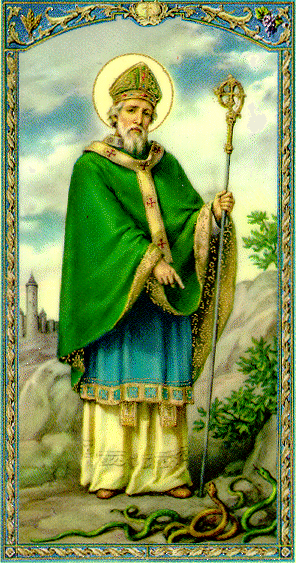
St. Patrick's Purgatory in Lough Derg, a place of penitential pilgrimages since the 12th century, has prob- ably no connection with the saint. The earliest picto- rial representation of St. Patrick dates from c. 900. The two most common ones-Patrick's expelling all poison- ous snakes from Ireland and his symbolizing the Holy Trinity by the shamrock leaf-are based on legend.